Artificial intelligence
Where AI can realistically improve clinical decision support in neurological disease
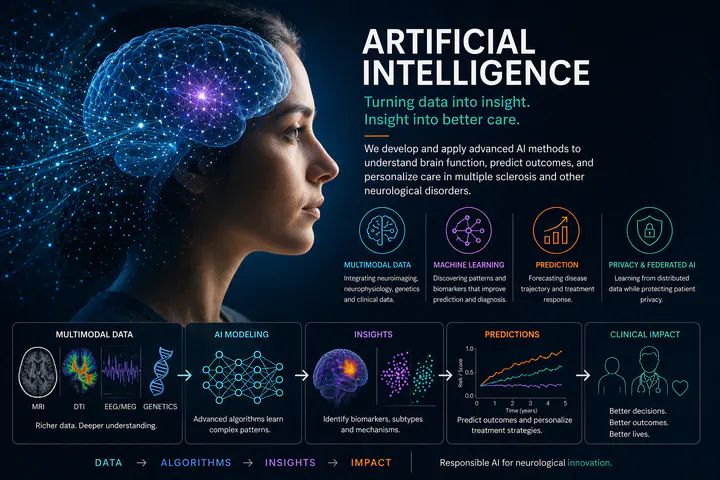
We study where artificial intelligence can genuinely add value in clinical neurology, with a focus on cognitive impairment, prognosis, and scalable analysis of multimodal data.
Why this matters
AI is often presented as a universal solution in healthcare. Our work instead asks where machine learning is robust, clinically meaningful, and realistic in neurological disease.
Current directions
- AI for cognitive and clinical stratification
- Federated learning across distributed clinical datasets
- Methodological work on generalisability, bias, and clinical utility
Earlier work
One of my earlier explorations of AI in clinical care evaluated whether machine-learning approaches could detect metabolic syndrome in patients treated with antipsychotic medication. That work highlighted a recurring lesson in medical AI: apparent accuracy can depend strongly on the population under study.
On AI in MS care
We have contributed to the debate on whether AI will transform multiple-sclerosis care in the coming decade. For me, the important question is not whether AI is fashionable, but whether it improves decisions, scales across centres, and remains interpretable enough for clinical use.
Related outputs
See the Publications page for selected work on AI, federated learning, and digital biomarkers.

Jeroen Van Schependom
Associate Research Professor
Cognitive impairment, multiple sclerosis, neurophysiology, neuroimaging, neuromodulation, and computational biomarkers