Neuromodulation
Exploring non-invasive neuromodulation in neurological disease
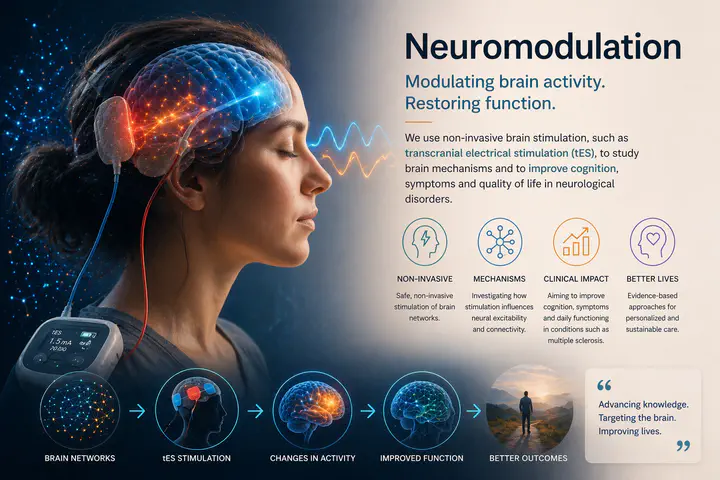
Transcranial electrical stimulation is a promising but still developing field for the treatment of neurological disease. Our work asks not only whether stimulation can transiently improve cognitive performance, but also whether repeated stimulation can induce more durable biological change.
Rodent research
A major open question is whether repeated stimulation can enhance remyelination and through which mechanisms. We are therefore developing experimental work in mice to test the effects of repeated alternating-current stimulation.
Simulation and modelling
Non-invasive brain stimulation is strongly affected by inter-individual anatomical differences. We therefore study how modelling choices, especially tissue segmentation, influence simulated current density and how this affects interpretation in people with neurological disease.
Why this matters
The long-term goal is to move toward neurocomputationally informed stimulation strategies that are biologically plausible, individually tailored, and clinically meaningful.
Related outputs
See the Publications page for selected work on neuromodulation, remyelination, and stimulation modelling.

Jeroen Van Schependom
Associate Research Professor
Cognitive impairment, multiple sclerosis, neurophysiology, neuroimaging, neuromodulation, and computational biomarkers