Neurophysiology
Understanding how brain dynamics support cognition and how they fail in neurological disease
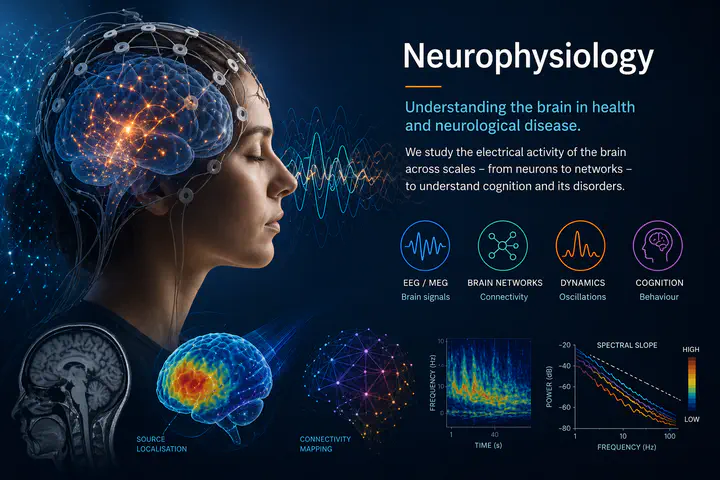
Because cognitive impairment is difficult to assess objectively, we study brain activity directly to understand how neurological disease alters large-scale brain function.
Brain dynamics
Modern neurophysiology increasingly goes beyond static connectivity analyses. We study transient brain states with distinct spatial, temporal, and spectral signatures, because these short-lived states offer a window on the timescales at which cognition unfolds.
Spectral analysis
Oscillatory activity, especially in the alpha range, has repeatedly been linked to cognitive impairment in multiple sclerosis. A central question in our work is how specific these associations are and which aspects of cognition they capture most strongly.
Excitation and inhibition
The 1/f spectral slope has been proposed as a marker of excitation-inhibition balance. We study how this measure changes under pharmacological manipulation and whether it can help explain variation in cognitive functioning in neurological disease.
Why this matters for biomarkers
By linking dynamic brain activity to cognition, we aim to build biomarkers that are closer to mechanism than conventional behavioural testing alone.
Related outputs
See the Publications page for selected work on MEG, transient brain states, oscillatory activity, and spectral slope measures.

Jeroen Van Schependom
Associate Research Professor
Cognitive impairment, multiple sclerosis, neurophysiology, neuroimaging, neuromodulation, and computational biomarkers