Temporally Defined Brain Network Activation Associated With Slowed Information Processing Speed in Multiple Sclerosis.
Abstract
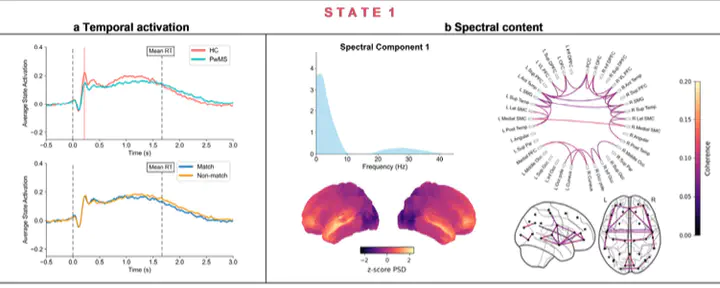
Information processing speed (IPS) is a core cognitive deficit in people with multiple sclerosis (PwMS). Previous efforts have associated IPS performance to frontal regions, but were constrained by limited temporal resolution. In this work, we employed a data-driven method, the time delay embedded-hidden Markov model (TDE-HMM), to identify task-specific states that are spectrally defined with distinct temporal and spatial profiles. We used magnetoencephalographic (MEG) data recorded while healthy controls and PwMS performed a cognitive task designed to capture IPS, the Symbol Digit Modalities Test (SDMT). The TDE-HMM identified five task-relevant states, supporting a tri-factor contribution to IPS: sensory speed (occipital visual detection and processing), cognitive speed (prefrontal executive and frontoparietal attention shift), and motor speed (sensorimotor). We observed reduced prefrontal activation in PwMS, while peak features across prefrontal, frontoparietal, and occipital networks were associated with task reaction time and clinical SDMT performance. This work can drive future research for MS treatments targeting IPS improvements.