Transcranial alternating current stimulation at 10 Hz promotes oligodendrogenesis and reduces g-ratio after cuprizone-induced demyelination.
Abstract
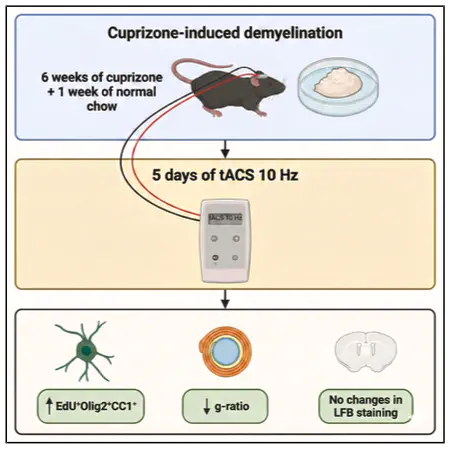
Multiple sclerosis (MS) is characterized by demyelination and incomplete remyelination. While numerous disease modifying treatments are available, none of these have been shown to aid in remyelination. In this study, we examined the remyelinating potential of transcranial alternating current stimulation (tACS) at 10 Hz in the cuprizone (CPZ) model. Our experiments show that 1 week of tACS during the recovery phase of the CPZ model could accelerate the maturation of newly formed oligodendrocytes and increase the relative myelin thickness of axons without changing the gross myelin content. Cognitively, mice treated with tACS showed specific improvements in spatial memory performance. Overall, these findings indicate that tACS can promote oligodendrogenesis and myelin repair in vivo in a non-invasive manner, highlighting its potential as a translatable strategy for people with MS.